
Among the Sensex firms, State Bank of India, Infosys, Titan, Tech Mahindra, IndusInd Bank, NTPC, ICICI Bank, Power Grid, Reliance Industries and Kotak Mahindra Bank were the major laggards. On the other hand, Tata Motors, Nestle, Hindustan Unilever, Tata Steel, Bajaj Finance and UltraTech Cement were among the gainers.

The primary market is expected to remain vibrant, with at least 10 companies, including supermart major Vishal Mega Mart and Blackstone-owned diamond grading firm International Gemmological Institute (India) Ltd expected to raise a combined Rs 20,000 crore in the next month, merchant bankers said. Education-focused NBFC Avanse Financial Services, TPG Capital-backed Sai Life Sciences, hospital chain operator Paras Healthcare, and investment bank DAM Capital Advisors are also among the companies planning to launch their IPOs in December, they added. The companies aim to raise a total of Rs 20,000 crore through their public offerings.
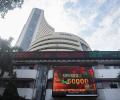
The top 10 valued firms added a total Rs 1,56,317.17 crore to their market valuation last week, helped by across the board rally which catapulted the benchmark index Sensex to the record 60,000 mark for the first time. During the last week, the 30-share BSE benchmark rallied 1,032.58 points or 1.74 per cent. The BSE Sensex made history on Friday by reaching the 60,000-mark for the first time ever. The market capitalisation (mcap) of Reliance Industries zoomed Rs 58,671.55 crore to reach Rs 15,74,052.03 crore. The m-cap of RIL went past Rs 16 lakh crore mark in intra-day trade on Thursday following a rally in its share price.

'The biggest near-term risk to Indian equities is the outflow of investments to China as tactical trades by foreign investors.'
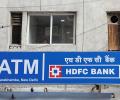
HDFC Bank's market capitalisation (market cap) touched Rs 13 trillion in Thursday's (December 28, 2023) intra-day trades as the largest private sector lender is set to report its sharpest monthly rally in the past two years. At 10:33 AM; HDFC Bank's market cap stood at Rs 13.03 trillion, the BSE data shows. The stock was up 1 per cent at Rs 1,717.90 in intra-day trades on December 29, inching towards its record high of Rs 1,757.80 touched on July 3, 2023.


The sharp pullback in mid and smallcap stocks signals a cooling-off period in segments that previously attracted considerable investor interest.

the largest transactions of the year include the merger of Quality Care India and Aster DM Healthcare valued at $5.08 billion, followed by Bharti Enterprises' acquisition of a 24.5 per cent stake in the BT Group at $4.08 billion, and a family settlement transaction in the Godrej family at $3.5 billion.

'Investors looking at the next 6-12 months can be certain that the Fed will maintain its easing cycle, and we expect the overall environment to be conducive for fixed income investments for portfolio diversification.'

Facing criticism from the government over the central bank prioritising inflation over growth, the new RBI Governor Sanjay Malhotra on Monday said that prospects of the Indian economy are expected to improve on the back of high consumer and business confidence in 2025. "As we strive to preserve financial stability to support a higher growth path for the Indian economy, our focus remains steadfast on maintaining stability of financial institutions and, more broadly, systemic stability," Malhotra said in foreword to the Financial Stability Report.

Billionaire Gautam Adani-led Adani Group on Tuesday said it will acquire CK Birla group firm Orient Cement at a valuation of Rs 8,100 crore as part of its expansion drive. Ambuja Cements, the cement and building material company of Adani Cement and part of the diversified Adani Group, has signed a binding agreement for the acquisition of Orient Cement Ltd (OCL) at an equity value of Rs. 8,100 crore.

Foreign portfolio investors (FPIs) have net sold domestic shares worth over $10 billion so far this month amid a shift to China, which not only offers attractive valuations compared to India but has also announced several measures to support the economy and the stock market in recent weeks. If the trend doesn't reverse, this will be the first time that overseas funds will yank out more than $10 billion from Indian equity markets in a month.

'In 2022, active management, long-short strategies, multi-asset strategies, and asset allocation strategies need to be considered to meet long-term investment goals.'

The total market valuation of the BSE-listed companies is nearing the Rs 100 lakh crore-mark following the continued dream run of the bourse.

Over the past week, the BSE benchmark index Sensex gained 474.79 points to end at 25,519.22
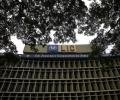
The government is unlikely to come up with the IPO of Life Insurance Corporation (LIC) in the current financial year ending March 2022, as the valuation of the state-owned behemoth is taking more than anticipated time, and the preparatory work is still far from complete. There are still some issues that need to be addressed with regard to the valuation of LIC, a senior official of one of the merchant bankers said. Even after the valuation, there are several regulatory processes that have concluded, the official said.

Equity investors became richer by Rs 2.4 lakh crore as key benchmark indices Sensex and Nifty scaled new peaks in morning trade on Tuesday, amid persistent foreign fund inflows. Analysts said foreign institutional investors have reversed their selling strategy and have been consistent buyers during the last seven days. This momentum is a reflection of institutional confidence in the Indian market, they said.

From the 30 blue-chip pack, Mahindra & Mahindra, IndusInd Bank, Bajaj Finance, Tata Motors, Bajaj Finserv, Nestle and ICICI Bank were the biggest gainers. State Bank of India, Tata Steel, Adani Ports, Zomato, UltraTech Cement and HCL Tech were among the laggards.

The rally in Indian mid-and smallcap indices thus far in calendar year 2024 (CY24) has been the best in class across the world, eclipsing the global FTSE benchmarks, and also out running peers from other leading world stock markets. This is despite the correction in the mid-and smallcap segments back home seen in the last few days, triggered by valuation concerns, geopolitical developments amid nervousness ahead of the July - September 2024 (Q2-FY25) corporate results season.

A sharp sell-off in the Indian equities markets after a spike in crude oil prices should not be surprising. Historically there is a negative correlation between stock valuations in India and the price of Brent crude oil, which is the benchmark for the Indian crude oil basket. Between 2011 and 2014, crude oil traded above $100 a barrel for an extended period, the Sensex-trailing price/earnings (P/E) was 18X, on average, during the period, nearly 22 per cent lower than the current index P/E of 23X.

If you already hold significant amounts of equity in your portfolio, avoid MAAFs with over 60 per cent equity. But if you lack equity exposure, an aggressive MAAF may be appropriate.

Metropolitan Stock Exchange of India (MSE) plans to raise Rs 120 crore from investors in an attempt to stay afloat. The beleaguered exchange's board has approved issuance of 1.19 billion equity shares of face value Rs 1 at a premium of Rs 1 through private placements, according to a disclosure on its website.

It has been a choppy calendar year 2022 (CY22) for global financial markets amid the spectre of rising inflation that led most central banks, especially the US Federal Reserve (US Fed), to tighten their monetary policy. Most equity indices across the globe have seen a sharp fall from their respective peak levels in this backdrop. FTSE India, for instance, has corrected 16 per cent from its October peak.


'Those satisfied with returns and not expecting further rally could be booking profits and also stopping SIPs.'

Smaller stocks continue to shine at the bourses. The BSE MidCap index is up 18 per cent since the beginning of January this year against a 5 per cent rise in the Sensex during the period. With the current rally, the mid-cap index has doubled in value since the end of March 2020 against a 70 per cent rally in the Sensex during the period. On Tuesday, the mid-cap index closed at 21,232, as compared to 17,941 at the end of December 2020. In the same period, the benchmark index moved from 47,751 to 50,193.

Udaan, India's largest business-to-business (B2B) e-commerce company, has received approval from the National Company Law Tribunal (NCLT) for its internal corporate restructuring plan, according to sources. By consolidating into a single entity, the restructuring will enhance Udaan's agility and pave the way for various financing options, including the ability to pursue an initial public offering (IPO) in India by 2026, according to people familiar with the matter.

At the same time, seven companies from the coveted list witnessed a decline in their market valuation last week, but their cumulative loss of Rs 37,701.1 crore was less than the total gain made by three firms.

'Such big falls are quite frequent these days, so do not try to time this market.' 'Use big dips to accumulate quality stocks.'

Data from Amfi shows that NAV of every one in two BAFs declined 1.5% or less on Monday compared to a 3.13% decline in Nifty 500.
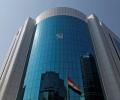
The Securities and Exchange Board of India (Sebi) on Monday relaxed the norms for valuing perpetual bonds. The norms, which had sought to value banks' deemed residual maturity of Basel III additional tier 1 (AT1) bonds as 100-year debt from April 1, were strongly opposed by the finance ministry. In a statement released on Monday, the regulator said the maturity would be 10 years until March 31, 2022, and would be increased to 20 and 30 years over the subsequent six-month period.

The recent depreciation of the rupee along with sharp fall in the country's foreign exchange (FX) reserves has sparked a debate whether stability of the exchange rate is necessary and desirable. The rupee was one of the least volatile currencies among peers for almost two years before the current downward pressure started in September after the US Federal Reserve lowered interest rate.

Nine of the top-10 most valued domestic companies together added a whopping Rs 2,22,591.01 crore in market valuation last week, with heavyweights RIL, TCS and HDFC twins gaining the most. During the last week, the BSE benchmark Sensex rallied 1,690.88 points or 3.21 per cent. The index reached its all-time high of 54,717.24 on August 5. Barring Bajaj Finance, rest nine companies -- Reliance Industries Ltd (RIL), Tata Consultancy Services (TCS), HDFC Bank, Infosys, Hindustan Unilever Ltd (HUL), ICICI Bank, HDFC, State Bank of India and Kotak Mahindra Bank -- logged gains.
The 55 basis point (bps) spike in the US 10-year bond yield, triggered by a combination of FOMC's hawkish commentary and BOJ's relaxation of the yield control curve (YCC) has made analysts cautious on Asian equities and expect them to trade sideways in the short-to-medium term.

Though most analysts expect the global central banks to keep the liquidity tap open, valuations of Indian markets, they say, are beginning to look stretched. Against this backdrop, they remain cautious, with some even expecting a minor correction from here on.

'Investors should focus on largecap funds, flexicap funds, business cycle funds, or hybrid-category funds.'

Global brokerage firm CLSA has reversed its early tactical shift from Indian equities to Chinese stocks, and has decided to raise India allocation while cutting exposure to China. In its report titled 'Pouncing Tiger, Prevaricating Dragon', CLSA cited challenges facing Chinese markets in the aftermath of Donald Trump's victory in the US elections as the reason for the move. "Misfortune can happen in threes. So it has played out for Chinese equities over the past week.
Debt management is going to be a worry for the Vedanta group until FY25 at least. However, the restructuring of business divisions in Vedanta India could lead to an unlocking of values. The group structure is fairly complex. Anil Agarwal-led Vedanta Resources (VRL), which is London-listed, has a lot of debt on the balance sheet. It will have to repay $1 billion in secured bonds by January 2024 and at least another $300 million in calendar 2024.

'In the short term you keep your return expectations very, very low; in the medium term be prepared to invest and in the long term growth will come and your returns from stocks will be high.'

The medium-term scenario for oil marketing companies (OMCs) is high risk due to the surging crude and gas prices. Apart from OPEC-plus cutting production, the Hamas-Israel conflict has caused fears of supply disruption. The July-September quarter of 2023-24 (Q2FY24) saw positive surprises for OMCs. Strong gross refining margins (GRMs) more than offset weak marketing margins.
